Introduction
Accountants are not going to be measured simply by their knowledge of accounts anymore. They are going to be measured based on their understanding of systems that manage clients.
The role of an accounting professional is undergoing significant changes. Once, the expectation for accountants was straightforward: handle books, create reports, handle taxes, stay compliant, and be technically proficient at what you do. Those standards are still valid, yet they don't cut it anymore.
Currently, accounting firms expect professionals to know about clients, workflows, communication tools, and business management. The fastest-growing accounting firms are those with a client-focused and tech-enabled approach, and the accountants who thrive in such environments are those who have an understanding of systems and finances combined.
Learning about CRM is one of the most important things to learn for a young accountant.
What Is CRM? And Why Does It Matter?
CRM is the abbreviation for Customer Relationship Management, and it is a type of system that allows businesses to keep track of their client information, communication history, follow-ups, tasks, and all the service-related data in one centralized place.
For accounting firms, a CRM allows keeping track of client inquiry history, progress in onboarding, documents requested, follow-ups, service renewals, and engagement. CRM is often referred to as a tool that is helpful to sales teams; however, in today's accounting practice, CRM serves as the operational backbone of the company, allowing everyone from the communication department to the bookkeepers to see the whole picture of client service.
CRM knowledge will help any young accountant become much more useful in the firm.
Why Do Accountants Need to Learn About CRM
Accounting Gets More Client-Focused
As accountants interact more and more with business owners, financial managers, and company founders, they should be able to communicate in an organized manner and answer questions related to the entire history of the account. CRM can help you get a complete overview of the history, so you can answer clients' questions more efficiently.
CRM Improves Follow-Up and Communication
Tasks like handling tax forms, auditing, and sending regular financial reports usually involve frequent follow-ups with the client. A CRM can help you avoid confusion since everything regarding your communications is stored in one place and not scattered across your inbox anymore.
Accountants Have Access to More and More Data
All kinds of CRM systems nowadays store a lot of data regarding clients, their history, interaction with your firm, business insight, and more. An accountant who knows how to analyze this kind of data becomes more useful to the firm's leadership.
Automations Get Integrated Into Accounting Operations
Automation features in CRM allow assigning tasks to specific members, creating reminders for document collection, setting service renewals, and much more. An accountant who understands these features can use the system to optimize his/her work processes, thus becoming more productive.
Advisory Role Needs Additional Information
As the future of the accountancy industry goes towards advisory models, your clients expect not only regular reports but also suggestions based on previous experience. CRM stores all of that information.
Practical Application of CRM Systems in Accounting Firms
Let's consider how a CRM system practically benefits an accounting firm.
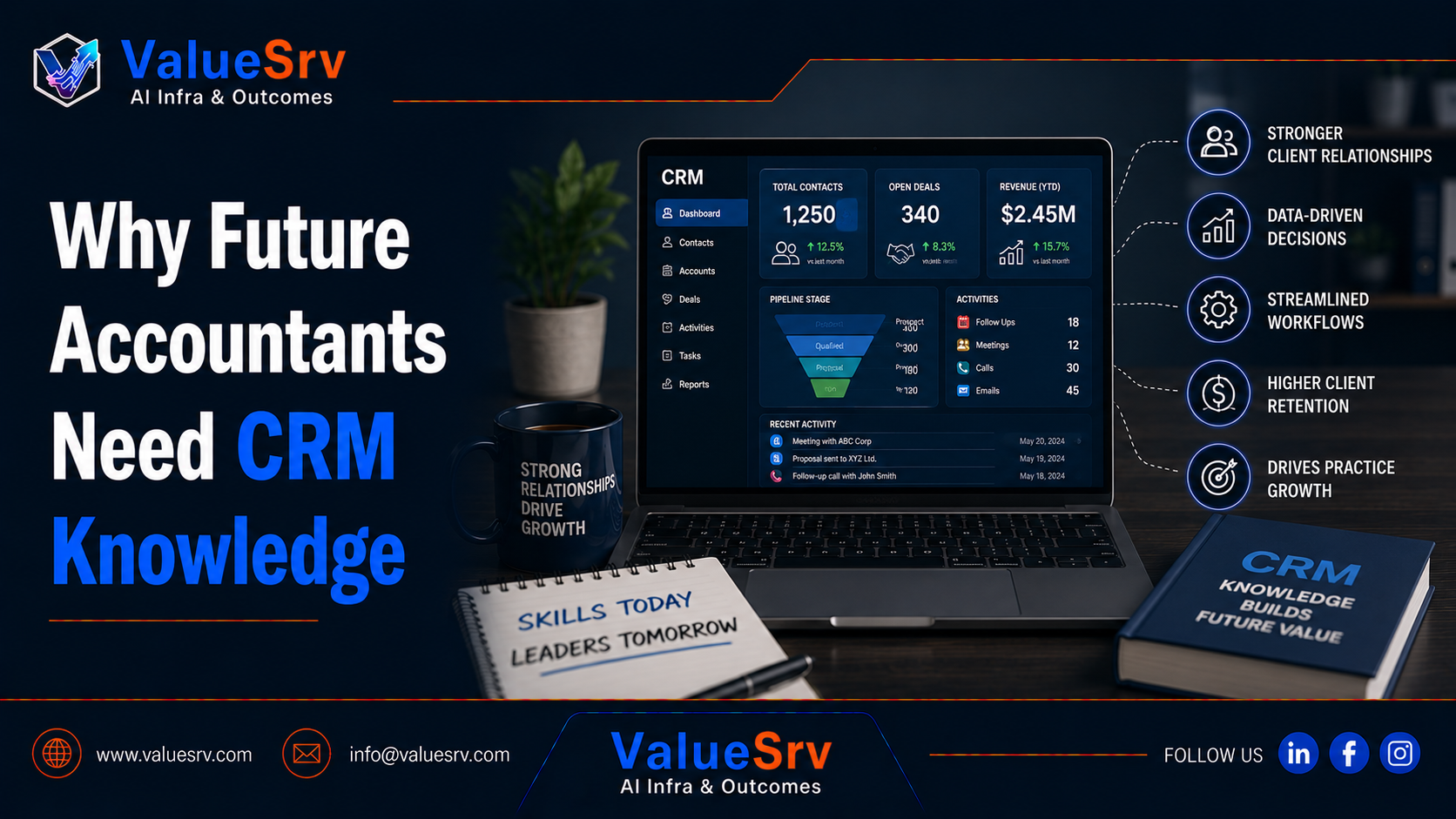
CRM can help structure your client onboarding since all new client information, documentation required, the team responsible for working with them, and milestones are tracked in this system. Document follow-ups can be easily managed using reminders in the system. Task tracking will allow you to get visibility on pending actions and follow-up tasks for the clients. Every single contact and communication, call, note, and follow-up email is located in one centralized place. All the service renewals and compliance deadlines can be flagged in advance, and clients receive well-organized communication.
Important Skills Future Accountants Should Possess in CRM
It is clear that accountants don't necessarily have to become system developers and administrators; however, there are several skills related to CRMs that are extremely beneficial for professionals:
- Updating client information in the database.
- Following up with clients, tracking all the correspondence, and assigning tasks within the CRM.
- Understanding pipeline stages and knowing whether the client needs further assistance.
- Being able to read and understand dashboards to identify tasks pending completion.
- Working with client document follow-ups and reminding them to send documents in a timely manner.
- Learning how to set up some simple automation tasks.
- Coordinating with other departments based on the data gathered in CRM.
Those skills may not take you too long to learn yet provide substantial benefit throughout the rest of your career.
Benefits of CRM Knowledge for Career Development
By learning how to use CRMs, accountants become much more technology-oriented, capable of coordinating efforts in the firm, and more efficient in performing tasks related to client management. All firms running modern CPA practices, bookkeeping services, tax advisory firms, and other consulting services use CRMs in their operations every day. Young accountants who have basic CRM knowledge will require a much shorter onboarding period.
Common CRM Tools Used in Accounting Firms
The actual tool may differ depending on your employer, yet popular CRMs used by accounting firms include HubSpot, Zoho CRM, Salesforce, Pipedrive, and Monday CRM.
Conclusion
Young accountants need more than simply to master finance. To be able to successfully operate in a firm and have a good potential for career development, you need to know the systems, workflows, and client management techniques. Learning CRM becomes crucial for success in the accounting field.