Introduction
Many great accounting firms excel at providing services to clients but fail miserably at designing systems that enable them to deliver consistent service.
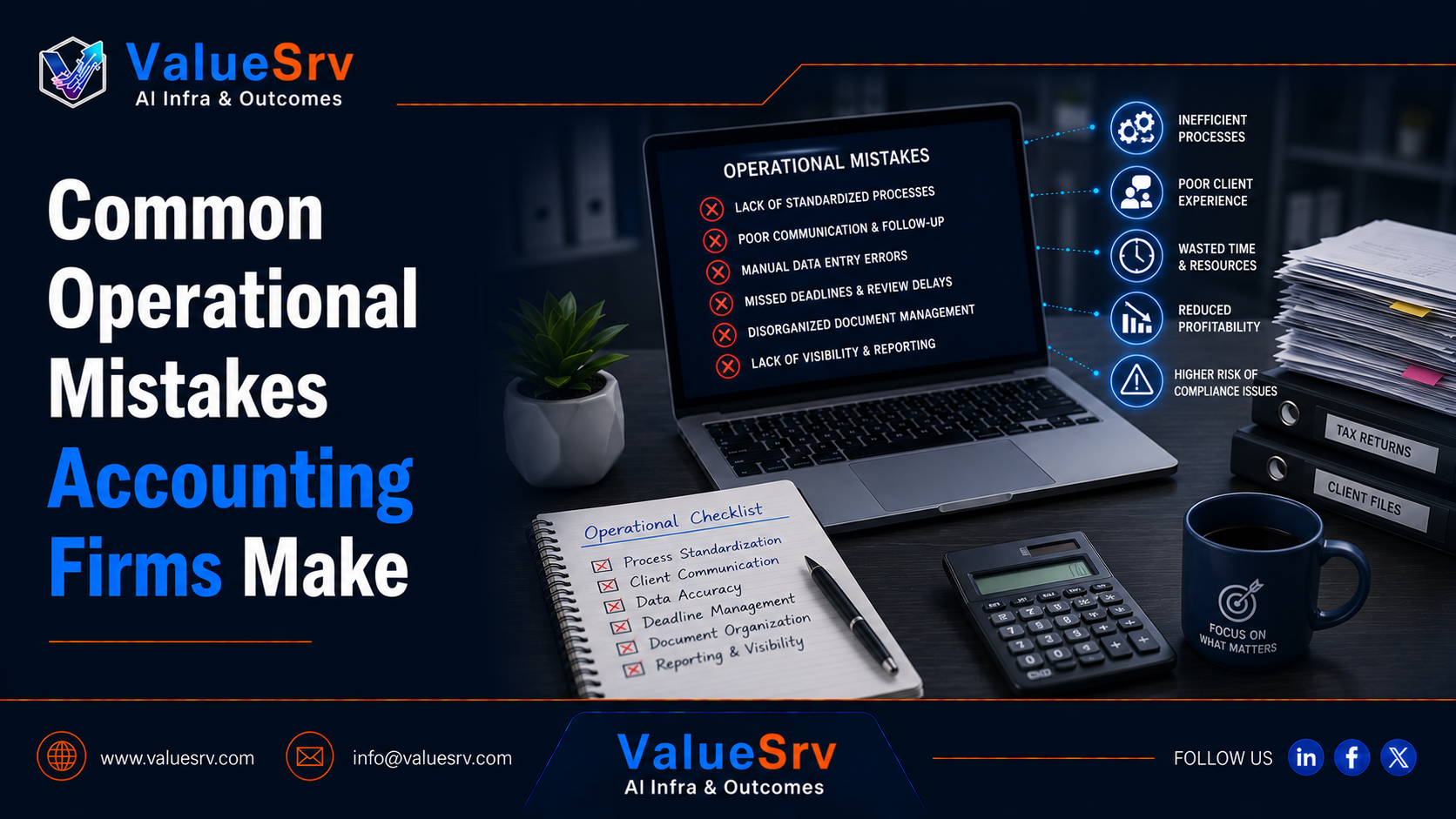
Technical knowledge is usually not an issue for most accounting firms. What really causes them difficulties is the fact that their operations are not designed to facilitate scaling. As a result, deadlines keep piling up, documents take time to be submitted, tasks require follow-ups, and coordination requires more time than execution.
Operational inefficiencies of this kind rarely show up on profit and loss statements. However, they silently reduce efficiency, affect the pace of delivery, negatively impact the customer experience, and create a ceiling on growth that is harder to overcome each year.
Mistake 1: Overreliance on Manual Follow-Up Processes
Manual client follow-ups, chasing of documents via email and WhatsApp, and informal tracking of deadlines are among the most common operational practices found in accounting firms. At first glance, they might seem harmless until the number of clients starts growing and teams have to waste countless hours every week on something that could be automated.
This results in delays in document collection, deadlines being missed due to a lack of reminders, staff getting overwhelmed by unnecessary tasks, and clients noticing that something is not quite right.
However, follow-up workflows and document collection systems are easy to automate and replace manual chasing with structured and efficient communication.
Mistake 2: Improper Client Intake Process
An inefficient intake process creates problems long before the accounting work is done. The process of onboarding itself often lacks a structured checklist, involves asking clients the same questions multiple times, receiving insufficient information at the very beginning of the engagement, and having no proper handoff process from the initial stage to the delivery stage.
All this creates a bad first impression and internal inefficiencies that define the further course of client interactions. By implementing a structured client intake automation process, accounting firms eliminate all these issues.
Mistake 3: Ineffective Use of Software
CRM software in one place, documents in another, tasks are tracked in spreadsheets, communication takes place via email and WhatsApp, and reports are created manually at the end of each month. When tools used are not connected, teams waste time and effort on switching between systems, errors increase, and visibility is lost.
Using more software will not necessarily improve operational performance. On the contrary, if not integrated, it will only make everything even more complicated.
Therefore, what accounting firms need is an effective use of workflow automation tools for accounting firms.
Mistake 4: Lack of Clarity in Task Ownership
Without clarity on who is responsible for executing particular tasks, work gets blocked between different departments, managers are busy following up on updates, and deadlines are informally tracked through messages and verbal agreements.
This results in duplicate efforts, a lack of accountability, and delayed client deliverables without anyone intending or foreseeing it. What is required in this case is a structured process of task routing and workflow ownership with full visibility on the dashboard.
Mistake 5: Poor Documentation of Standard Operating Procedures (SOP)
Without written-down procedures, accounting firms find it difficult to scale. New employees have to rely on more experienced colleagues for basic task execution, similar questions are asked multiple times within the team, quality depends on the person who does the job, and managers spend much time explaining how things should be done.
Instead, accounting firms need to document processes in their accounting SOP infrastructure in the form of onboarding checklists, process manuals, and searchable knowledge bases.
Mistake 6: Absence of Operational Dashboards
The biggest challenge for accounting firms' leaders is that they realize there are operational inefficiencies only after a deadline is missed or a client raises a complaint. There is no way of monitoring pending tasks in real time, no dashboard highlighting bottlenecks, and no data about the team's productivity.
What accounting firms need is to gain the ability to monitor pending work in real time and make resourcing decisions based on the information available.
Mistake 7: Thinking That Growth Is Only About Marketing
Many accounting firms allocate a lot of money for marketing to attract more clients. However, they fail to implement the necessary operational infrastructure to effectively serve the increased number of clients.
As a result, their growth becomes problematic instead of giving a competitive advantage.
How ValueSrv Helps Accounting Firms Address Their Operations Gaps
ValueSrv helps accounting and finance firms design an accounting operational infrastructure that enables them to provide efficient service to their clients.
It includes client intake workflows, document collection automation, follow-up systems, integration of tools, documentation of SOPs, workflow automation, task routing, reporting, and dashboarding.
Conclusion
Operational inefficiencies that affect accounting firms are not related to the absence of technical knowledge. They are connected to ineffective processes such as manual follow-ups, improper intake processes, a lack of clarity regarding task ownership, disconnected tools, and poor SOP documentation.
While they may seem minor, these mistakes have a direct impact on the pace of work, customer experience, and ultimately – profitability.